Launch pricing: the full kit, 129 illustrated pages, is $27 while we're newLaunch pricing: full kit, 129 pages for $27
The Handyman Business cover Finding Customers and Running the Day cover The Job List cover

The Whole Handyman Business. Explained With Drawings.

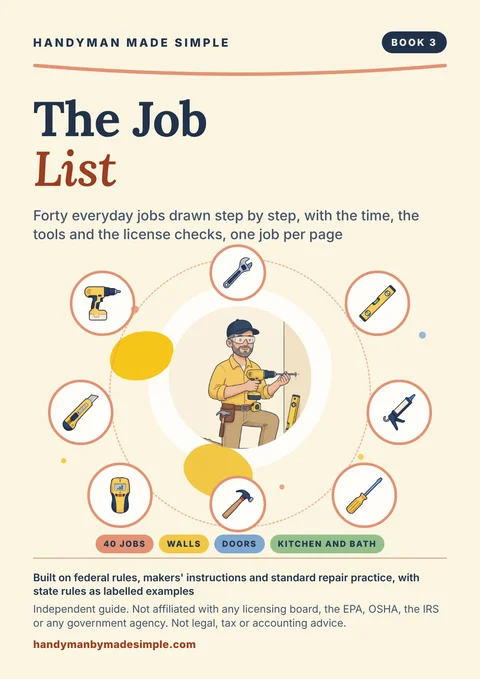
Three illustrated guides for running a handyman business: what you can take on without a license, insurance, flat-rate pricing, trip charges and the paperwork; finding customers, quoting, scheduling and property manager accounts; and 40 everyday jobs drawn step by step, with the time and the materials. One idea a page, each one drawn.

Secure purchase No subscription 7-day guarantee

Here's what the pages look like

Real pages from all three guides. One idea a page, drawn.

What's included

Three illustrated guides

The Handyman Business, Finding Customers and Running the Day, and The Job List. 129 pages, one idea each.

One idea, drawn

The idea, the picture, the costly mistake and one line to remember. Read it in the truck between jobs.

Made for your phone

Phone-sized PDFs to check at the customer's door or in the store aisle, yours to keep. Nothing to cancel.

You know how to fix it. Nobody taught you the business.

Most of the money a new handyman business loses goes quietly: a rate copied from a friend, parts sold at cost, a favor that never made the invoice. Every one of them has a page, and every page names the mistake.

Where handyman businesses lose money:

Quoting each item on a customer's list as its own visit, so six drives eat your week

Selling materials at cost, then paying for every return trip and wrong size yourself

Doing “while you're here” extras as a favor and billing them at the end

From Book 1 · Pricing

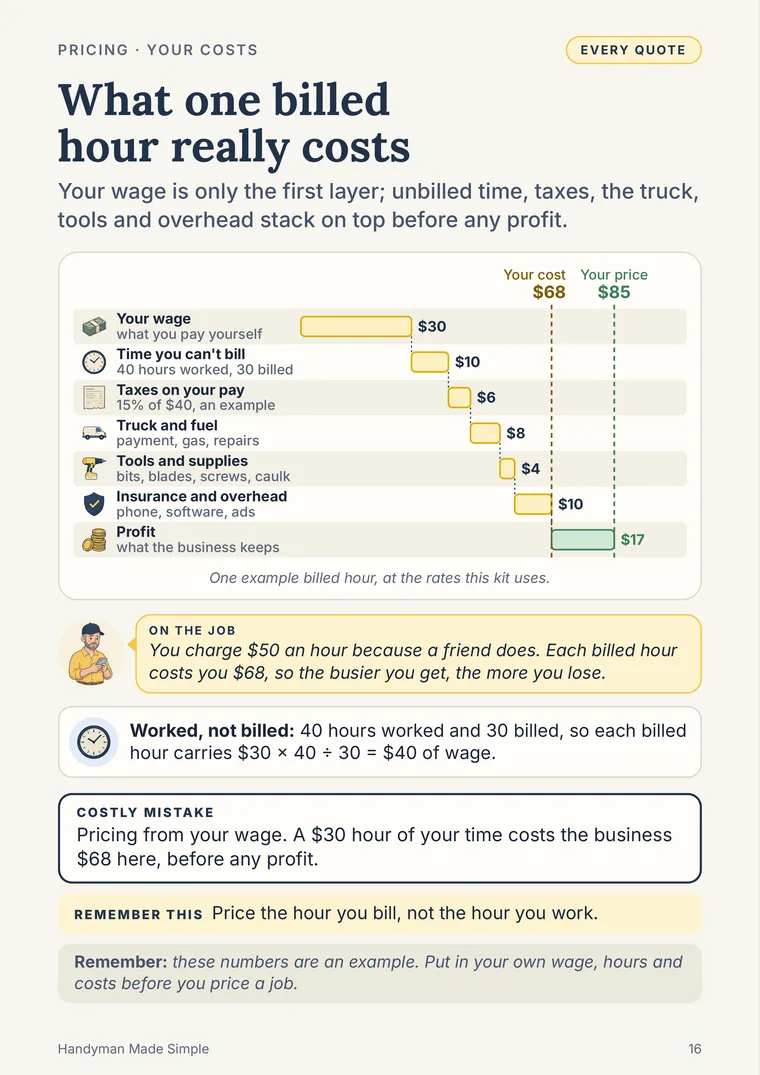
What one billed hour really costs

Book 1, page 16, What one billed hour really costs: in the kit's example, a $30 wage is $68 of cost and an $85 price per billed hour
From Book 1 · page 16
Remember this Price the hour you bill, not the hour you work.
On the job You charge $50 an hour because a friend does. Each billed hour costs you $68, so the busier you get, the more you lose.

A drawing is easier to take in between jobs than a paragraph. That's why every page in the kit has one, and one line to keep.

Same tools, same town. A very different year.

From this

Learning it the expensive way

  • A group thread at midnight that argues with itself about what to charge for a TV mount
  • A quote that sounds fair, and no number of your own to check it against
  • Finding out after the job that the outlet you swapped needed an electrician's license
To this

The page for this decision

  • One idea, one drawing, read in a minute
  • What it looks like on the job, on the same page
  • The costly mistake named, so you skip it instead of paying for it

One page, up close

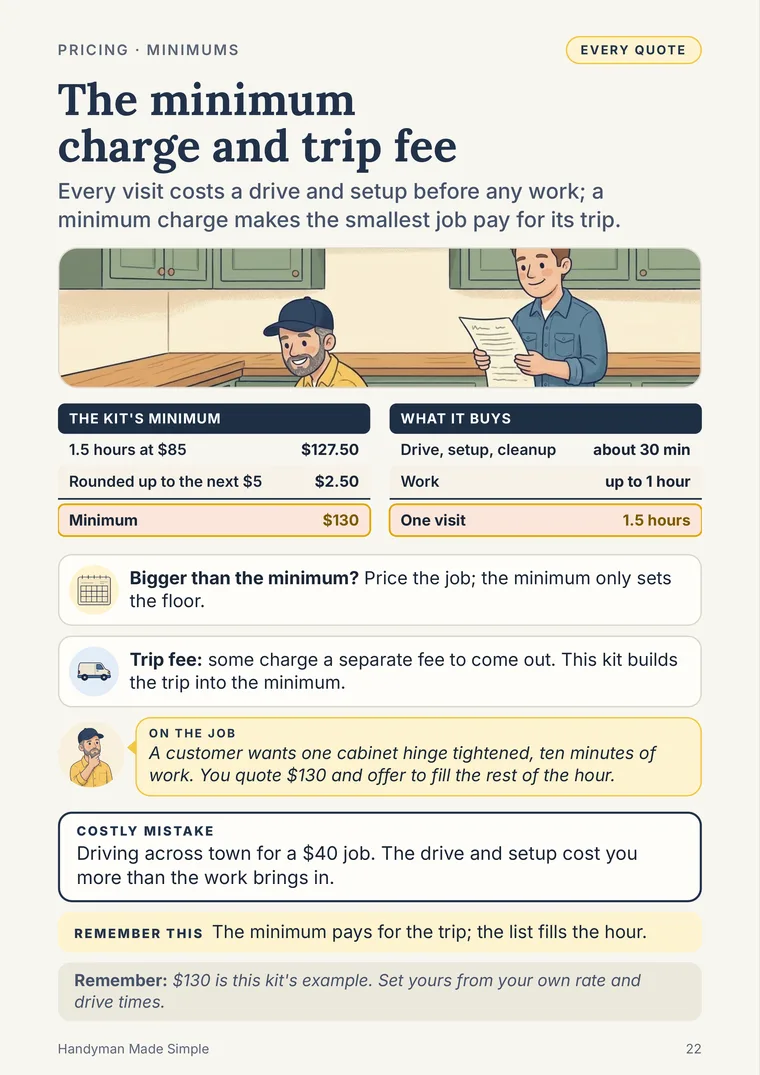
Every page has the same parts, so you always know where to look. Here is Book 1, page 22, The minimum charge and trip fee, with its lines quoted from the guide.

Book 1, page 22, The minimum charge and trip fee: the whole page
The idea

Every visit costs a drive and setup before any work; a minimum charge makes the smallest job pay for its trip.

On the job

A customer wants one cabinet hinge tightened, ten minutes of work. You quote $130 and offer to fill the rest of the hour.

Costly mistake

Driving across town for a $40 job. The drive and setup cost you more than the work brings in.

Remember this

The minimum pays for the trip; the list fills the hour.

Quoted word for word from Book 1, page 22, The minimum charge and trip fee. Every page carries these parts plus the drawing, and where a rule changes from state to state, a note that says so.

The three guides

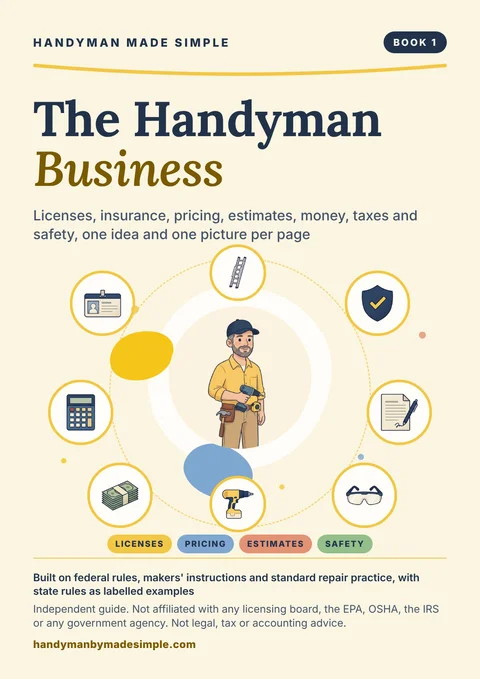
Book 1: The Handyman Business

48 teaching pagesSix partsEvery page drawnSet up and get paid

What you can take on without a license, insurance, pricing, the paperwork, money and taxes, and safety, one idea a page. Six parts: Starting out, Insurance, Pricing, Paper, Money and Safety. Start with what one billed hour really costs.

  • Starting out: sole owner, LLC or corporation, your first-year setup checklist, keeping business money separate, what you may do without a license, work that needs a licensed trade, when a job needs a permit, lead paint in homes built before 1978, asbestos, mold and other hidden hazards, advertising that says only what's true, records to keep and for how long
  • Insurance: general liability for damage you cause, your tools and your truck, workers' comp when you hire, certificates of insurance, bonds are not insurance
  • Pricing: what one billed hour really costs, overhead, hours worked and hours billed, markup and margin, hourly or flat rate, building a flat rate from your time, the minimum charge and trip fee, materials and customer-supplied parts, pricing what you can't see yet, raising your prices
  • Paper: what a written estimate says, a simple work agreement, deposits and down payment limits, the three-day right to cancel, changes in writing, getting paid when the job ends, your workmanship promise and callbacks, damage on the job
  • Money and safety: break-even hours, job costing, paying yourself a real wage, self-employment and estimated taxes, truck costs, writing off tools, 1099s, sales tax on handyman work, employee or contractor, subbing out licensed trades, ladders, eyes, ears, lungs and hands, power, water and gas off first, working inside someone's home
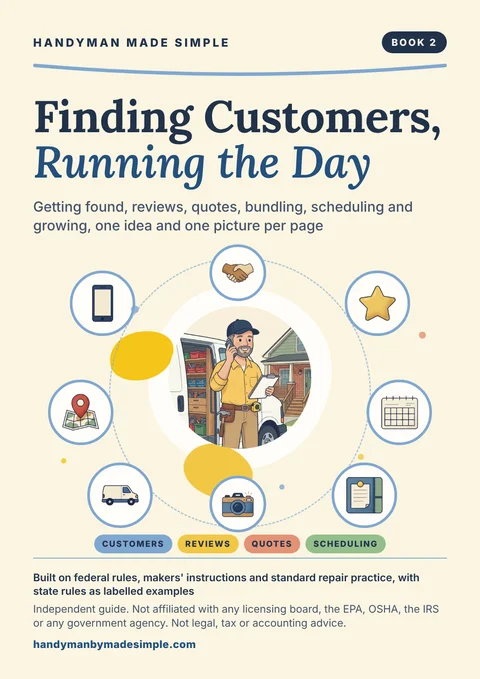
Book 2: Finding Customers and Running the Day

36 teaching pagesFive partsEvery page drawnFirst call to paid

From the first call to the walk-through and the next booking, in the same layout.

  • Your market: what a handyman business sells, four kinds of customers, jobs to turn down, your service area
  • Getting found: your Google Business Profile, reviews, neighborhood apps and groups, what a lead app job really costs, a one-page website, truck, shirt and door hangers, property managers and landlords, realtors and inspection repair lists, the twice-a-year home visit, referrals
  • Quoting: the first call or text, quoting from photos or a visit, the estimate visit in twenty minutes, turning a list into one visit, good, better, best options, following up on quotes
  • The day and growth: planning the week by area, a realistic day on the calendar, the text before you arrive, the truck stock list, buying materials before the job, arrive, protect, work, clean, the walk-through and sign-off, when a job goes wrong, hard customers, software, photos, your numbers every week, your first helper and training them, four ways to grow, when to get a contractor license

Book 3: The Job List

45 teaching pages40 jobsEvery page drawnTime and materials

The work you sell: 40 everyday jobs drawn step by step, with the time and the materials, and a check-first box on every page.

  • Before you start: reading the job before you take it, shutting off, testing and protecting, finding the stud and picking the anchor
  • Walls and doors: nail holes, fist-size and big drywall holes, cracks and popped screws, heavy mirrors, TV mounts, shelves, blinds and curtain rods, closet rods, doors that stick or won't latch, knobs and deadbolts, weatherstripping, sliding doors, window screens, bifold doors, hollow door patches
  • Kitchen, bath and floors: recaulking a tub, a running toilet, showerheads, grab bars, towel bars, cabinet hinges, drawer slides, regrouting, squeaky floors, baseboard, a cracked floor tile, vinyl plank in a small room
  • Outside, safety and paint: gutters from a ladder, sagging gates, fence pickets, deck boards, caulking outside gaps, assembling and anchoring furniture, smoke and CO alarms, childproofing, video doorbells, touching up paint
  • Check first: faucets and toilets, and lights, fans and outlets, where many states require a licensed plumber or electrician. These pages show what to check, not how to do the work.

Here's everything you get

Finding Customers and Running the Day The Handyman Business The Job List

The Handyman Made Simple Kit

  • The Handyman Business53 PDF pages, 48 teaching pages: licenses, insurance, pricing, the paperwork, money, taxes and safety
    $45
  • Finding Customers and Running the Day40 PDF pages, 36 teaching pages: getting found, quoting, scheduling, accounts and growth
    $25
  • The Job List50 PDF pages, 45 teaching pages: 40 everyday jobs drawn step by step, with the time and materials
    $25

Total value: $95

Launch price
$27

One-time payment. No subscription. Keep the files forever.

Yes, I want the kit for $27
Secure purchase No subscription 7-day guarantee
Payments by Stripe

Digital guides (PDF), in English. We email your library link right after purchase, and you can download the files again anytime. Plus sales tax where applicable.

Handyman Made Simple is an independent guide for people running a handyman business. It explains rules in plain words and is not legal, tax or accounting advice. It is not affiliated with any licensing board or government agency.

Is this kit for you?

Turning side jobs into a business

You can fix most things in a house; the business side is new. Book 1 lays out the setup, what you may take on without a license, the insurance and the paperwork, then what a billed hour really costs.

Busy every day, and the month still doesn't add up

The calendar is full and the account is still thin. Flat rates, the minimum charge, materials markup, bundling a list into one visit and planning the week by area each get a page, worked with example numbers you can swap your own into.

Ready for steady accounts or a helper

Before you take on a property manager's turnovers, a realtor's repair list or your first helper, see what they expect, how to price and invoice them, and the coverage to have first, one page at a time.

How this kit is made

No gimmicks. Public federal rules, state licensing patterns, product labels and makers' instructions, drawn clearly, with the source named on the page where it matters.

Built on named sources

The license pages follow state contractor licensing boards; the lead paint page follows the EPA's Renovation, Repair and Painting rule; the safety pages follow OSHA's rules; the tax pages follow IRS publications; the job pages follow makers' instructions and the Consumer Product Safety Commission. Every page was checked against its named sources before release.

Honest about your state

How big a job you can take on without a contractor license, which work needs a licensed trade, deposit limits and sales tax on handyman work all change from state to state. Those pages teach the pattern, label any state rule as an example, and point you to where yours lives.

Example numbers, shown working

The money pages work the same example rates all the way through: a $30 wage that costs $68 a billed hour and is priced at $85, a $130 minimum, and materials at cost plus 25%. You can see where each number comes from and swap in your own. The examples are examples, not prices for your market.

Independent, on purpose

Not affiliated with or endorsed by OSHA, the EPA, the U.S. Department of Labor, the IRS, the Consumer Product Safety Commission, any state contractor licensing board or any trade association. We answer to the owner.

7-day money-back guarantee

Use the kit for 7 days. If it isn't for you, email us and you get 100% of your money back. No fine print, no hassle.

Questions, answered

How do I get it?

Right after purchase we email you a link to your library, where you download all three guides as PDFs. You can come back and download them again anytime.

Is this a one-time payment or a subscription?

One-time payment of $27. No subscription, no recurring charges, and nothing to cancel. All three guides are yours to keep.

Who is it for?

People running a handyman business in their first few years, solo or with a helper, and anyone about to turn side jobs into a business of their own.

Which state is it for?

Every state. The books teach what works the same way everywhere: pricing, insurance, customers and the jobs themselves. Where a rule changes by state, like how big a job you can take on without a contractor license, the page says so and shows you where to look up yours.

Does it teach electrical, plumbing or gas work?

No. In nearly every state that work needs a trade license. The Job List has check-first pages for faucets, toilets, lights, fans and outlets that show what to check and when to call a licensed trade, and Book 1 shows how to sub that work out.

Is it legal or tax advice?

No. Handyman Made Simple is an independent guide for people running a handyman business. It explains rules in plain words and is not legal, tax or accounting advice. It is not affiliated with any licensing board or government agency. Your lawyer, accountant and insurance agent apply the rules to your business.

Do I need to buy anything else?

No. The kit is complete on its own.

The Flat-Rate Price Book cover

At checkout there is one optional add-on, The Flat-Rate Price Book: your hourly cost worked out with blanks for your own numbers, an example flat rate for each of the 40 jobs in The Job List, and blank sheets to price the jobs you do most. It's $7.90, unticked, and you can skip it.

Can I use it on my phone? Can I print it?

Both. The pages are portrait and phone-sized, so you can check one at the job or in the store, and the PDFs print if you want a page in the truck.

Will it make my business profitable?

We don't promise that, and we'd be wary of anyone who does. The guides show you how each piece works and the mistake that costs money, with the numbers worked on the kit's example rates. Which jobs you take and what you charge is still your call.

What if it isn't for me?

Email us within 7 days of purchase and we'll refund 100% of your money. Details on the refund policy page.

One last thing before you decide

Every job with your own name on the truck teaches you something about the business side, and the expensive lessons come with a bill. You don't need another midnight group thread or a rate someone swears by. You need the page for this decision, with the idea drawn and the mistake named.

Get instant access
Access confirmed ·
Full kit$27
Get instant access
The full kit · $273 illustrated guides · 129 pagesGet instant access